NZ Business Growth Guide•Verified Insight

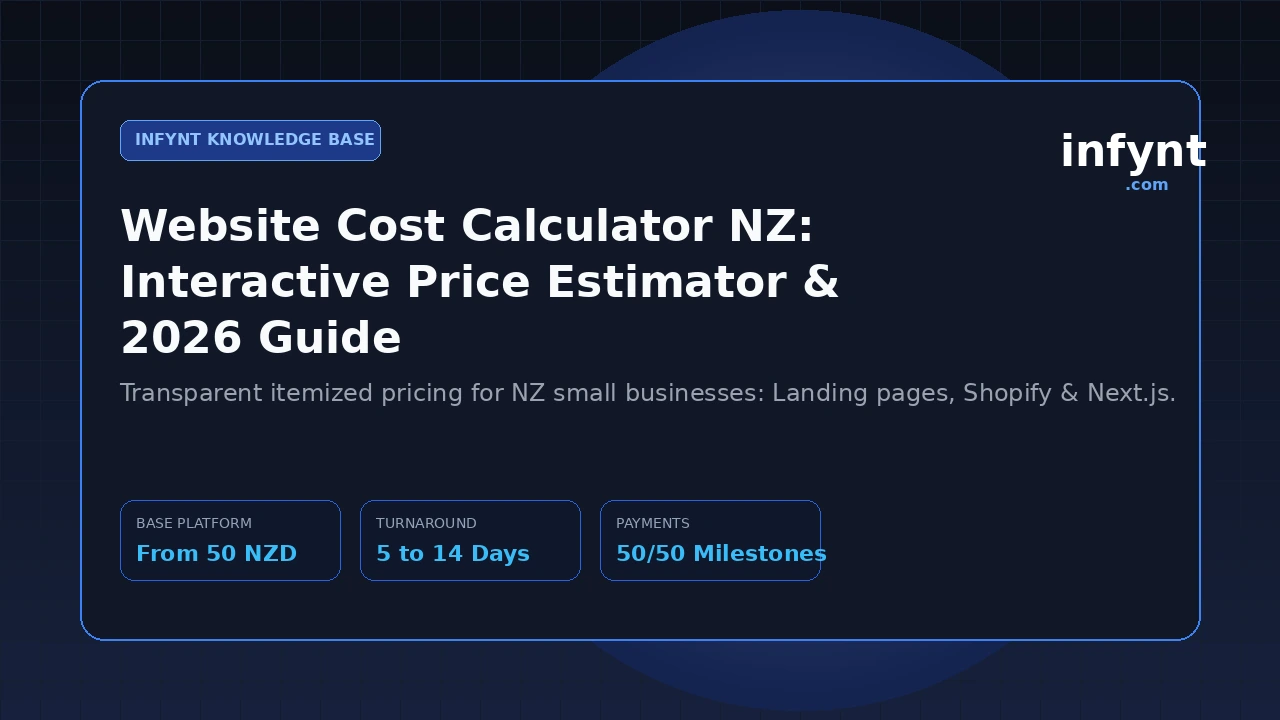
Website Cost Calculator NZ: Interactive Price Estimator & 2026 Guide

11 min read•Palmerston North & Manawatū•Published: September 2026

Executive Summary & Scope

Navigating web design pricing in New Zealand often feels like guesswork. Quotes for a standard small business website swing from 00 on local boards to upwards of 5,000 from metropolitan agencies for nearly identical functional scope. This guide details real 2026 market rates across New Zealand, exposes hidden ongoing maintenance traps, explains IRD tax treatment, and introduces an interactive cost calculator so Kiwi business owners can plan their digital investment with total clarity.

Website Cost Calculator NZ: Interactive Price Estimator & 2026 Guide

1. Why NZ Website Quotes Swing from 00 to 0,000+

If you have ever requested web design quotes from three different New Zealand agencies, you have likely received three wildly conflicting estimates: one for ,200, one for ,500, and one for 4,000 + GST. This variance is rarely about software licensing costs; it reflects vastly different operational models, overheads, and development approaches across the Kiwi market.

Metropolitan agencies in Auckland and Wellington maintain substantial office leases, dedicated account managers, UX copywriters, and front-end developers, pushing their project minimums above ,000. At the opposite end, overseas freelancers on gig platforms charge under 00 but often leave clients stranded with broken mobile layouts, no understanding of the New Zealand consumer landscape, and zero post-launch accountability. Mid-market boutique studios like Infynt bridge this gap by delivering enterprise-grade custom engineering on modern frameworks like Next.js at transparent, fixed prices starting from 50.

2. Real Market Pricing Tiers for New Zealand Websites in 2026

To accurately budget for your business website, it helps to understand how the New Zealand market breaks down into four core functional tiers:

  • Tier 1: Single-Page High-Conversion Landing Page (50 – ,000 NZD): Ideal for trades, solo practitioners, or seasonal marketing campaigns. Includes custom hero section, service overview, social proof badges, and an integrated enquiry form optimised for mobile devices. Turnaround: 5–7 business days.
  • Tier 2: Standard 5-Page Small Business Website (,995 – ,000 NZD): The foundational standard for Kiwi professional services, clinics, and local companies. Encompasses Home, About, Services, Dedicated Contact/Booking, and Portfolio pages with full on-page SEO, Google Business Profile alignment, and analytics tracking. Turnaround: 10–14 business days.
  • Tier 3: E-Commerce Store (,495 – 0,000+ NZD): Fully configured Shopify or custom WooCommerce platforms with payment gateways (Windcave, Stripe, Afterpay), inventory management, automated shipping rates via NZ Post or CourierPost, and product catalog setup. Turnaround: 2–4 weeks.
  • Tier 4: Bespoke Web Applications & Portals (,500 – 5,000+ NZD): Custom internal workflows, client self-service portals, database-backed directory platforms, and bespoke API integrations. Turnaround: 4–8 weeks.

3. Agency vs Freelancer vs DIY: Calculating Total Cost of Ownership

Many business owners initially gravitate towards DIY website builders like Wix or Squarespace, believing they will save money. While initial subscription fees appear low (5–0/month), the hidden cost is business owner time. Spending 40 to 60 hours assembling template blocks often results in poor Google PageSpeed scores, broken mobile responsiveness, and lack of search discoverability—costing thousands in lost enquiries.

Hiring a solo freelancer offers affordable customisation, but introduces single-point-of-failure risk if they relocate, switch careers, or take on full-time employment. Partnering with a dedicated engineering studio provides structured development contracts, milestone guarantees, and guaranteed long-term support without agency bureaucracy.

4. Exposing the Hidden Recurring Costs of Website Ownership

A complete website cost calculation must account for annual operational expenses beyond the upfront build fee:

  • Domain Registration: .co.nz or .nz domains cost approximately 0 to 0 NZD per year. Beware of registrars offering first-year deals that renew at exorbitant rates.
  • Hosting & Infrastructure: Traditional WordPress sites require managed hosting (0–20/month) to prevent slowdowns. In contrast, modern Next.js static and serverless architectures on platforms like Vercel deliver global CDN distribution and automated SSL at negligible or zero monthly hosting cost for standard traffic levels.
  • Plugin & Software Licences: WordPress sites frequently depend on paid plugins (form builders, SEO plugins, security shields, page builders) totaling 00–00/year. Custom headless sites eliminate third-party plugin vulnerability and subscription bloat.
  • Security & Maintenance Retainers: Active software updates, security patching, and uptime monitoring typically range from 50 to 00/month for businesses wanting hands-off peace of mind.

5. How to Use Infynt’s Interactive Cost Calculator

Rather than waiting days for vague estimates, Infynt provides an open, real-time Interactive Website Cost Calculator. Built specifically for the Kiwi market, it allows business owners to select their preferred platform tier, layer in high-value capabilities like 24/7 AI customer service chatbots, automated Xero invoicing sequences, or local SEO packs, and view an exact itemized estimate instantly.

The calculator also displays the transparent 50/50 milestone payment schedule, ensuring you know your exact deposit and completion balance before booking a project discovery call.

6. Inland Revenue (IRD) Tax Treatment for Kiwi Business Websites

In New Zealand, the tax deductibility of website expenses depends on whether the expenditure is considered capital development or regular operational maintenance under IRD guidelines:

  • Ongoing Operating Expenses: Domain renewals, web hosting, monthly maintenance retainers, and minor content updates are fully deductible revenue expenses in the financial year incurred.
  • Initial Website Creation: Developing a new business website or undertaking a major architectural overhaul is generally treated as capital expenditure on software assets. Under current IRD depreciation schedules, software development can typically be depreciated at 40% diminishing value or 50% straight line.
  • Low-Value Asset Threshold: Assets costing under ,000 (such as a 50 landing page) may qualify for immediate write-off in the tax year of purchase. Always consult your chartered accountant or tax advisor regarding your specific situation.

7. Essential Scope Checklist: What to Demand Before You Sign

Before committing to any web development proposal in New Zealand, verify that the contract explicitly addresses these non-negotiable standards:

  1. 100% Code & Asset Ownership: Confirm that all source code, graphic assets, domain registrations, and analytics accounts belong exclusively to your company upon final settlement.
  2. Fixed-Price Scope: Ensure the proposal is a fixed quote rather than open-ended hourly billing, with any scope extensions agreed in writing.
  3. Core Web Vitals & PageSpeed: Demand guaranteed mobile performance scores of 90+ on Google PageSpeed Insights.
  4. Structured Schema Markup: The build must include valid Schema.org JSON-LD (LocalBusiness, Organization, BreadcrumbList) for search engine crawlability.
  5. Zero Vendor Lock-in: The site must be hostable on standard cloud infrastructure without proprietary agency platforms holding your data hostage.

8. The Infynt Advantage: Engineering Precision at Fixed Rates

Infynt approaches web development with radical transparency. We do not sell bloated CMS themes or retain ownership of your digital assets. Every website is custom-engineered using modern web standards, loads in milliseconds, and is directly measurable via Google Search Console and Vercel Analytics.

Explore our transparent packages on our Pricing & Packages page or calculate your instant estimate using our Interactive Website Cost Calculator today.

Tired of DIY Hurdles? Partner with Infynt.

We engineer custom, blazing-fast websites and Shopify stores for Palmerston North and New Zealand businesses. Transparent fixed pricing, 40/30/30 milestone payments, and 100% code ownership.

Frequently Asked Questions

How much does a basic business website cost in New Zealand?

A professionally built basic 5-page small business website in New Zealand typically costs between ,500 and ,500 NZD. At Infynt, our 5-page business website package is fixed at ,995 NZD, covering custom design, mobile responsiveness, on-page SEO, and complete code ownership.

What ongoing monthly costs should a Kiwi business budget for?

For custom Next.js websites built by Infynt, baseline hosting and SSL are bash on standard serverless tiers, requiring only annual domain registration (~0–5/yr). For Shopify stores, software subscriptions start at ~9 USD/mo. Optional ongoing maintenance retainers run 50–00/mo for managed security and updates.

Are website development costs tax deductible in NZ?

Domain names, hosting, and monthly maintenance are 100% tax-deductible as business operating expenses. Initial website builds are generally treated as capital software assets depreciated at 40% to 50%, while one-page sites under ,000 may qualify for immediate write-off under IRD low-value asset thresholds.

How does Infynt ensure there are no surprise costs during development?

We work strictly on fixed-price contracts with milestone payments: 50% deposit to commence work and 50% upon live sign-off. Any requested features outside the agreed scope are quoted separately in advance.